


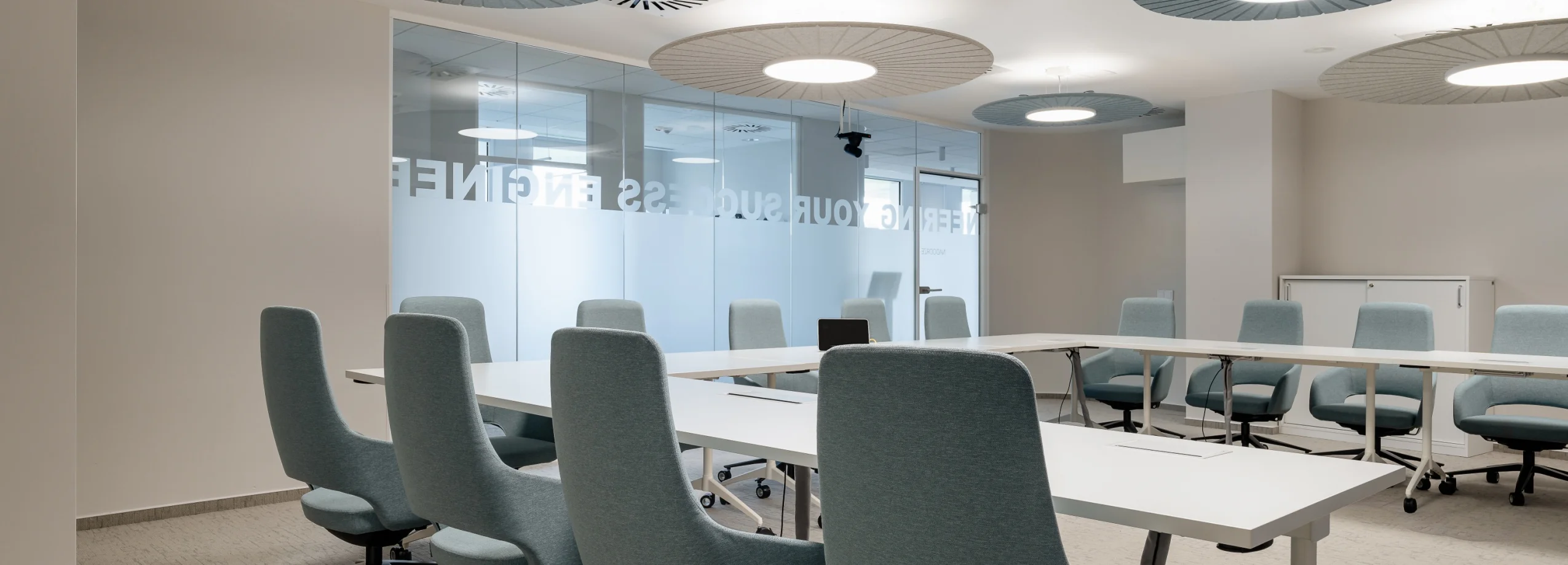
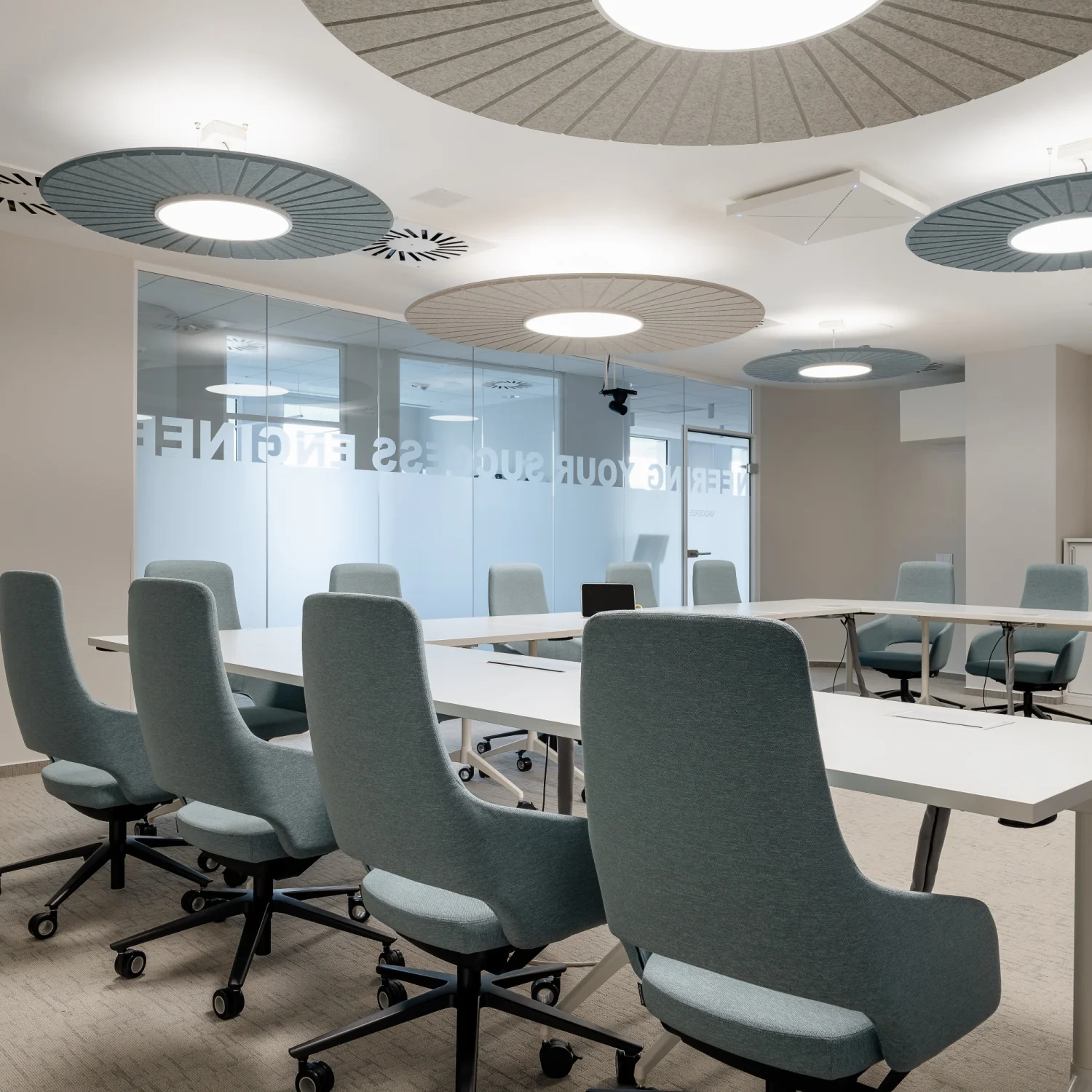
Best acoustic lighting solutions for meeting rooms
How to choose the right conference-room acoustic lighting for boardrooms, video conference spaces, and small meeting rooms, and why it matters more than you think.
The problem most meeting rooms share
Walk into almost any modern meeting room, and you will notice certain things immediately. The glass walls look sleek. The table is polished. The ceiling is either concrete or smooth plasterboard. The room looks professional, expensive, and well considered, and then someone starts talking, and the echo arrives.
This is one of the most common and most overlooked problems in contemporary office design. Meeting rooms are frequently designed around how they look rather than how they sound and feel to work in. Hard surfaces that create a clean, architectural aesthetic are the same surfaces that cause sound to ricochet around the room, making speech difficult to understand, creating a sense of acoustic fatigue that builds over the course of a meeting, and causing remote participants on video calls to struggle with what should be a straightforward conversation.
Lighting tends to receive similar treatment. Recessed downlights are installed because they look tidy. But tidy is not the same as good. Downlights create uneven illumination, cast shadows across faces, generate glare on screens and table surfaces, and do nothing to improve the acoustic environment they share. The result is a meeting room that looks right on a design render but underperforms in daily use, which is precisely the environment where performance matters most.
Acoustic lighting for meeting rooms exists to solve both problems at once. Rather than treating illumination and sound management as separate challenges requiring separate products, separate contractors, and separate ceiling penetrations, acoustic lighting integrates high-quality LED illumination with sound-absorbing materials in a single fixture. The outcome is a room that both sounds and looks significantly better, with fewer components, cleaner ceiling design, and a more coherent architectural result.
Why meeting rooms need more than good-looking fixtures
It is worth pausing to consider what a meeting room is actually required to do. At its most fundamental, it is a space for communication for people to exchange ideas, make decisions, present information, and reach agreement. Every environmental factor that facilitates communication supports the room's purpose. Every factor that makes it harder works against it.
Poor acoustics make communication harder in ways that are both obvious and subtle. The obvious effect is echo and reverberation: words blur into one another, the room feels loud even when only a small number of people are speaking, and participants unconsciously begin to raise their voices, which makes the problem worse. The subtle effect is cognitive fatigue. When the brain has to work harder to separate speech from reflected noise, it consumes more energy, leaving less available for the actual content of the meeting. People leave acoustically poor meeting rooms feeling more tired than the meeting should have made them, often without being able to identify why.
Lighting creates its own set of problems when it is poorly designed. Harsh downlights cast unflattering shadows across faces during video calls, making remote participants feel as though they are speaking to people in a poorly lit room rather than in a professional environment. Glare from surface reflections causes eye strain during long sessions. Insufficient or uneven illumination across the table creates a visual hierarchy: the people sitting under the lights are well lit, those at the ends of the table are not, which affects both the quality of the video call and the subtle social dynamics of the room.
Meeting-room lighting, when it is approached with genuine care, addresses all of these issues. It delivers uniform, high-quality illumination across the working surface, manages colour temperature to support alertness during long sessions, minimises glare, and renders skin tones accurately for video, all of which matter for both the people in the room and those joining remotely.
Acoustic lighting for meeting rooms brings these two priorities together in a format that also simplifies the ceiling architecture. Rather than a grid of downlights plus a set of separately installed baffles or panels, the room gets one coherent ceiling installation that does more, takes up less visual space, and performs better as a result.
How to choose the right acoustic lighting for your meeting room
The right meeting-room acoustic lamp is not universal. The best solution depends on the specific characteristics of the space, the way the room is used, and the acoustic challenges it presents. Understanding a few key variables makes the selection process considerably more straightforward.
Room size is the most fundamental consideration. A large boardroom with a ten-metre table has entirely different lighting and acoustic requirements from a four-person huddle room. Large spaces need fixtures that distribute light evenly along the full length of the table and provide sufficient acoustic absorption to reduce reverberation over a larger volume of air. Smaller spaces benefit from compact solutions that operate efficiently within a limited ceiling height without visually overwhelming the room.
Ceiling height determines how pendant fixtures perform. Acoustic pendant lamps work best when suspended at an appropriate distance above the working surface, typically between 60 and 90 centimetres above the table, depending on the fixture. At this height, they intercept sound waves before those waves reach the ceiling, absorb them within the fixture's material, and deliver light where it is needed most. In rooms with very low ceilings, surface-mounted or flush solutions may be more appropriate; in rooms with high ceilings, pendants can be suspended lower to improve both lighting distribution and acoustic effect.
Surface materials in the room tell you a great deal about the acoustic challenge you are working with. Glass partitions, concrete ceilings, wooden tables, and hard floor finishes all reflect sound efficiently. The more of these surfaces a room has, the greater the reverberation problem and the more acoustic absorption the lighting solution needs to deliver, potentially supplemented by wall-mounted acoustic treatment. A room lined with soft furnishings and carpeted floors presents a very different acoustic profile from a glass box with polished concrete.
Meeting style is an often-underestimated factor. A room used primarily for client presentations, where one person speaks to an audience, has different acoustic requirements from a room used for daily team discussions where multiple people speak simultaneously. Rooms where everyone talks benefit from stronger acoustic absorption because the density of speech makes reverberation more problematic. Rooms used heavily for video conferencing need particularly careful attention to both acoustics and lighting, since remote participants experience the room's acoustic and visual quality in a compressed, unforgiving format.
The right product for each type of meeting space
Flexxica's range of acoustic lighting solutions is designed to address the full variety of meeting room types encountered in professional office environments. Each product brings a distinct combination of acoustic performance, lighting quality, and design character and understanding which suits which context makes the specification process considerably cleaner.
For boardrooms and large conference rooms: Linea
The Linea is a linear acoustic lighting system developed specifically for the demands of large meeting spaces. Its format follows the logic of the conference table: a long, even source of light that runs the length of the workspace, providing consistent illumination to every seat without the bright spots and shadows that a series of point sources creates.
What makes Linea particularly well-suited to boardrooms is the combination of even light distribution and meaningful acoustic absorption across the full length of the fixture. In a large room where reverberation has significant space to build, a linear fixture running overhead intercepts sound waves across a wide horizontal plane, reducing the RT60 the time it takes for sound to decay without requiring additional ceiling installations. The result is a room where voices project clearly, where the visual environment supports long sessions without causing eye strain, and where the ceiling reads as a single coherent design element rather than a collection of separate components.
Linea is also particularly effective in training rooms and presentation spaces where the quality of the speaker's voice carries significant weight. In these environments, good speech intelligibility is not a comfort consideration; it is a functional requirement.
For medium meeting rooms and hybrid environments: BELLa
The BELLa Fabric Acoustic Pendant Lamp represents a different design philosophy: rounder, warmer, and more organic in character than a linear system, while delivering equivalent acoustic and lighting performance for medium-sized meeting rooms.
The fabric construction of the BELLa is central to its acoustic function. The textile surface absorbs sound across a broad frequency range, which is particularly valuable in meeting rooms where the mid-frequencies of human speech are the primary concern. Suspended over the centre of a meeting table, BELLa creates a defined acoustic zone directly above the working surface, the area where most of the relevant sound energy is generated and where reducing reverberation has the most immediate effect on speech clarity.
BELLa is an excellent choice for hybrid meeting environments rooms that host both in-person and remote participants on a regular basis. The fixture's warm, even illumination renders faces naturally and without harsh shadows, which is especially important for the experience of remote participants watching through a camera. At the same time, the acoustic performance reduces the echo that microphones pick up and transmit, making the audio experience for remote participants noticeably cleaner. In a world where hybrid meetings are a standard feature of professional life, this combination of considerations is not peripheral it is central to how well the room functions for its primary purpose.
For small meeting rooms and focus spaces: Easy Round
Smaller meeting rooms present a specific challenge: they tend to have very short reverberation distances but high levels of reflected energy, because the walls, ceiling, and table are all close together. Sound bounces quickly between parallel surfaces, creating a tight, uncomfortable acoustic signature that makes conversations feel effortful even though the room is small. The solution is not necessarily more acoustic treatment; it is well-placed, effective acoustic treatment in a format that suits the space's scale.
The Easy Round is designed for precisely this context. Its circular pendant format is compact enough to suit rooms where ceiling space is limited and where a large fixture would be visually overpowering, while delivering acoustic absorption and lighting quality that improves the environment meaningfully. In huddle rooms, focus rooms, interview rooms, and four- to six-person meeting spaces, Easy Round provides a clean, contemporary solution that does not compete visually with the room yet performs consistently in daily use.
The circular geometry also distributes light evenly in all directions from the pendant, which suits square or roughly square rooms better than a linear fixture would. For small meeting rooms where the table is as wide as it is long, this uniform distribution ensures that no seat is significantly better or worse lit than another.
For rooms with severe echo: BELLa or Linea combined with Pira Wall
In some meeting rooms, ceiling-mounted acoustic lighting alone is insufficient to meet the reverberation targets the space requires. This is particularly true of rooms with extensive glass surfaces, glass partitions, floor-to-ceiling windows, or glazed walls where vertical reflections are as significant as horizontal ones, and where the ceiling treatment cannot address the full acoustic problem on its own.
In these situations, combining ceiling acoustic lighting with wall-mounted acoustic treatment is the most effective approach. The Pira Wall is designed specifically for this complementary role. Mounted on the walls of a meeting room, Pira Wall absorbs reflected sound from vertical surfaces, working in concert with the ceiling fixture to address reverberation from multiple angles simultaneously.
The combination of BELLa or Linea above with Pira Wall panels on the surrounding walls is particularly effective in glass meeting rooms and boardrooms where the architectural aspiration of transparency, openness, and a connection to the surrounding office is acoustically demanding. Rather than forcing a compromise between visual quality and acoustic performance, this pairing allows the room to look exactly as intended while sounding as it should.
Acoustic lighting for video conferences: a special case
It is worth addressing video conference rooms separately, because the requirements of a hybrid meeting space differ in important ways from those of a purely in-person room.
When a meeting includes remote participants, the room effectively has two audiences: the people sitting in it and those watching it on camera. The in-room experience is shaped by what participants see and hear directly. The remote experience is shaped by what the camera captures and what the microphone transmits, and both of these are significantly affected by the quality of the room's lighting and acoustics.
Conference-room acoustic lighting that works well for video conferencing needs to deliver uniform illumination at a colour temperature that renders skin tones naturally, typically in the range of 3000 to 4000 Kelvin, without creating the harsh shadows or bright spots that cameras exaggerate. The fixture should illuminate faces from above and slightly forward, which pendant fixtures positioned over the table achieve naturally when hung at the right height.
Acoustically, video conference rooms need to minimise the reverberation that microphones pick up and transmit to remote participants. Echo on a video call is not just uncomfortable; it actively impairs communication, causing participants to talk over one another, hesitate, and lose the conversational flow that good decision-making depends on. An acoustic pendant positioned over the table, combined with wall treatment where the room's architecture demands it, substantially reduces this effect, producing a cleaner audio signal that makes the remote experience significantly more effective.
The long-term case for investing in quality
The decision to specify acoustic lighting for meeting rooms rather than conventional fixtures is not merely an aesthetic one. It is an operational decision with measurable consequences for how effectively the people using these rooms can work.
Better speech intelligibility means fewer misunderstandings, shorter meetings, and faster decisions. Better lighting reduces visual fatigue and improves on-screen professionalism. Better acoustics mean lower cognitive load throughout the working day, which is particularly significant in organisations where meetings occupy a large proportion of employees' time. And a more considered, integrated ceiling design means a space that continues to perform well over the lifespan of the fit-out, without the maintenance complications that come from managing separate lighting and acoustic product inventories.
The meeting room is one of the most intensively used and consequential spaces in any office. Choosing the right acoustic lighting for meeting rooms comes down to understanding the space, understanding how it will be used, and selecting products that address both the lighting and acoustic dimensions of that use with genuine performance rather than incidental benefit.
For large boardrooms and conference tables, Linea provides the linear, even illumination and acoustic absorption that long spaces require. For medium rooms and hybrid meeting environments, BELLa delivers warmth, acoustic performance, and the lighting quality that video conferencing demands. For smaller meeting rooms and focus spaces, Easy Round offers a compact, effective solution that suits the scale and geometry of intimate rooms. And where vertical reflections require additional treatment, Pira Wall complements any ceiling installation with wall-mounted acoustic absorption to address the space's full reverberation profile. Together, these products allow meeting rooms to do what they are designed to do: support clear, effective, comfortable communication for the people in the room and, increasingly, for those joining from wherever they happen to be.
More news
See all
flexxica at ORGATEC 2026
See flexxica products at ORGATEC 2026, taking place from October 27–30, 2026, at the Koelnmesse trade fair centre in Cologne, at the Glass System stand.
flexxica at Architect@Work Paris 2026
flexxica will be exhibiting at Architect@Work Paris on 21–22 October 2026 at the Grande Halle de la Villette. Come and see our acoustic lighting solutions in person.


